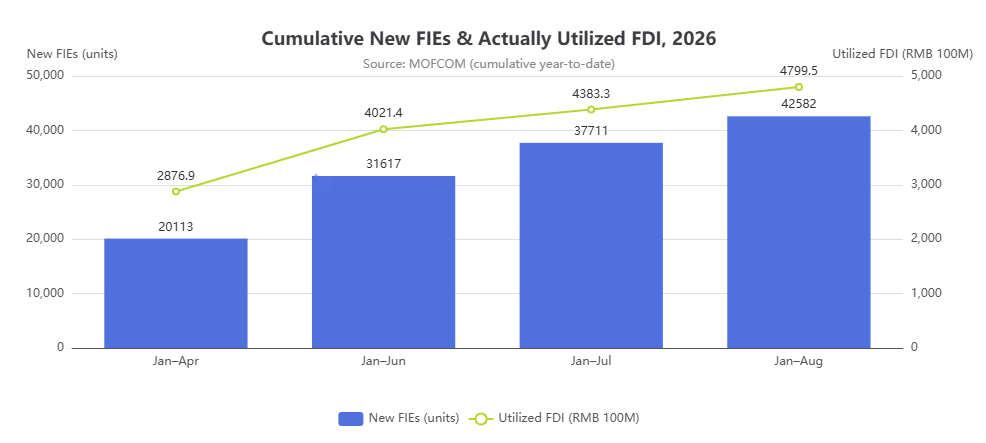
In the period from January to August 2026, China established 35,000 new foreign-invested enterprises, representing a year-on-year growth of 7.0% - China National Market Supervision Administration
1. Why should a foreign trader register a company in China at all?
You don't have to, but once your volume grows, working through a Chinese agent starts costing you more than it saves. Registering your own WFOE (Wholly Foreign-Owned Enterprise) unlocks:
Direct RMB and foreign-currency receipts — no more middlemen holding your money.
Import/export rights in your own name.
The ability to hire employees and pay social insurance directly.
Qualification to open Tmall, JD, and Douyin stores (see Question 10).
A local entity that can file trademarks, patents, and bid on tenders — something an offshore shell simply cannot do.
More trust from Chinese factories, landlords, and partners when you sign contracts under your own Chinese business license.
2. What does the registration process actually look like?
The standard WFOE setup follows seven steps:
Name approval (reserve your Chinese company name).
Submit incorporation documents to the Market Supervision Administration.
Collect the business license (营业执照).
Carve your chops — company seal, financial seal, legal-rep seal, invoice seal.
Open a bank basic account (基本户).
Tax registration and taxpayer classification.
(Optional but common) Customs, forex, and electronic-port filings for import/export.
Expect 2–6 weeks end-to-end, depending on the city and how fast your notarized investor documents arrive.
3. What are the real benefits of setting up in China?
Beyond the operational freedoms above, the structural wins are:
Limited liability — your personal assets are shielded.
You can issue Chinese fapiao (invoices) — Chinese B2B buyers often refuse to settle without one.
You qualify for high-tech enterprise status (15% income tax) if your R&D and patent portfolio meets the bar.
Your Chinese entity becomes the trademark applicant, which is required to defend your brand on Tmall and against copycats.
That last point is why, at our firm, we usually talk trademark and patent strategy at the same table as company registration — the two decisions are inseparable.
4. What documents do I need?
For a foreign investor, expect to prepare:
Notarized and apostilled / consular-authenticated copies of your overseas business license or certificate of incorporation.
Passport copies of the legal representative, directors, and supervisors.
Articles of Association (we draft this for you).
Proof of registered address — lease contract + landlord's property certificate.
Three to five candidate company names, your proposed business scope, and registered capital.
Occasionally a bank reference letter proving the investor is in good standing.
Plan ahead on the authentication step — this is where most timelines slip by 2–4 weeks.
5. Once the company is registered, can I open a Chinese bank account?
Yes. With your business license and chops in hand, you can open a basic deposit account at any major Chinese bank. This account handles withdrawals, payroll, and daily settlements.
Two practical notes:
The legal representative usually needs to be physically present for the face-to-face signing. A few banks now offer remote or overseas video onboarding — ask us before you book your flight.
Banks almost always visit and photograph your registered address before activating the account.
6. Do I need a real physical office?
You need a legitimate, commercial registered address — residential homes are generally rejected. The address must pass both:
Market-registry verification, and
Bank on-site verification.
Many foreign founders start with a serviced office or a compliant registered-address provider. That's allowed, but be honest with yourself: if you later plan to hire staff or run a warehouse, factor those leases in early.
7. What taxes will my Chinese company pay?
Here is the short version:
表格
| Tax | Rate / Scope |
|---|---|
| Corporate Income Tax | 25% standard; 15% for High-Tech Enterprises; small/micro enterprises pay much less on the first slabs of profit |
| VAT | 13% on goods, 6% on services, 9% on construction/transport; small-scale taxpayers use a 3% levy (with periodic reductions) |
| Surcharges | Urban maintenance tax + education surcharge ≈ 12% of VAT paid |
| Stamp duty | On contracts, capital, and records |
| Withholding / IIT | You deduct individual income tax from employee salaries |
| Customs duties & import VAT | Applies if you import physical goods |
Good news: China has been aggressively expanding the tax-preference catalog for advanced manufacturing, R&D, and regional free-trade zones. If your product qualifies — say, smart apparel or industrial machinery — the effective rate can drop substantially.
8. How much does it actually cost to set up?
The government registration fee itself is zero. The real costs are:
Registered address: roughly RMB 3,000–10,000+ per year, city-dependent.
Company chops: a few hundred to ~RMB 1,500.
Agency / filing service: RMB 5,000–15,000 if you use a local expert.
Bank account: no hard fee, but annual account-management fees apply.
Total first-year budget: around RMB 10,000–20,000 (≈ USD 1,400–2,800). Registered capital is subscribed, not paid-in, for most industries — you don't need to park millions in the bank on day one.
9. Do I need an annual inspection?
Formal "annual inspection" was abolished years ago. The modern requirement is the Annual Report Disclosure:
File between January 1 and June 30 each year, covering the prior calendar year.
Submit through the National Enterprise Credit Information Publicity System.
Miss it, and you land on the abnormal-operation list — which freezes bank accounts, e-commerce storefronts, and future trademark assignments.
We include annual-report filing as a standing service for all our registered clients, because one missed filing wipes out months of good standing.
10. Do I need a Chinese business license to sell on Tmall?
Yes — without exception. Tmall does not accept foreign-registered entities. To open a Tmall store you must have:
A mainland China business license (company form, not sole proprietorship),
General VAT taxpayer status,
A Chinese trademark (R mark preferred; TM mark may be accepted in some categories), or a formal brand authorization chain,
A corporate bank account settled in RMB.
This is exactly why so many overseas brands come to us in two steps: first register the WFOE, then file the Chinese trademark in the company's name, then apply to Tmall. Doing them in the right order saves months and avoids a rejected store application.